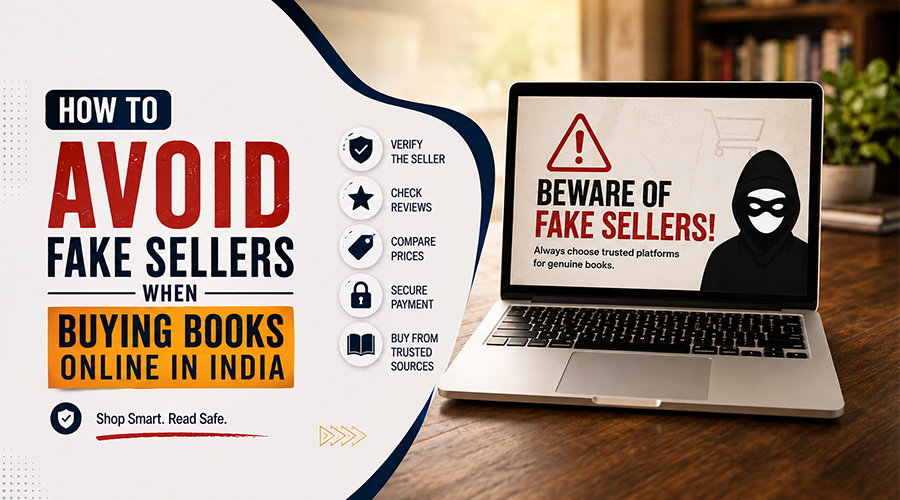
How to Avoid Fake Sellers When Buying Books Online in India
You recently heard from a friend about an online bookstore that offers books at the lowest prices. You thought you'd try it out. So, you visit their webstore and search for the title. You got it immediately and completed the payment process without a second thought. Now it's time to wait.
You receive the book 3 days later than the expected delivery period. Moreover, the binding is broken in the middle, so after a few days the pages will naturally come out of the book. The edition was not new; some pages were missing, and on others the writing felt faded. If this occurrence happens multiple times, then Buying Books Online in India feels terrifying.
This blog is all about how you can understand who the fake sellers are and the ideal ways to avoid them.
Why Fake Sellers Are a Concern
Online book buying has become part of everyday shopping, but convenience does not remove the need for caution. “New” books that are someone else’s “old”. Books with missing pages and mismatched editions. Orders that never show up at all are among the major issues in India’s online book market.
The Indian Copyright Office recently published a study confirming that nearly 20-25% of books sold in India’s book market are pirated. Don’t think of it as a rare, unfortunate problem; it’s a genuine, ongoing reality. But there are some smart ways to buy books online that help you identify the real sellers among the fake ones. Let’s learn how:
Top 8 Ways to Identify & Avoid Fake Book Sellers
1. Do Not Choose a Seller Only Because the Price Is Low
To everyone, a cheap book price always feels tempting, especially when the same title costs considerably more elsewhere. But price alone cannot tell you whether the copy is genuine. Before placing an order, compare book prices from various established sellers.
If one price label looks dramatically cheaper, closely check the edition, format, publisher, seller history, and condition. A simple comparison check can make buying books online in India much safer.
2. Read Reviews, But Do Not Trust the Star Rating Blindly
Don’t stop at the star ratings. Find recent reviews that reveal real problems with counterfeit copies, sloppy packaging, damaged covers, messy book condition, incorrect editions, or missing orders. Reviews that sound similar may be written by people known to the brand and can be entirely misleading.
Research published in Management Review Quarterly describes online reviews as an important source of information during consumers’ pre-purchase decisions. But always choose sellers with more reviews, cause not all reviews can be fake at the same time.
3. Check the ISBN, Publisher, and Edition
An ISBN is a 13-digit number that acts as a primary key. Before placing the order, check it carefully against your publisher and edition requirements. This step is especially helpful when you’re buying academic titles.
Textbook piracy is not new. Since 2024, the government of India has seized over 4.7 lakh pirated NCERT books, and when such news comes to light, it has literally shaken the market.
4. Be Suspicious of Listings With Missing Details
Buying Books Online in India feels safe when you’re buying them from a trusted bookstore, where everything about the book is mentioned. Don’t forget to check book titles, author name, language, publisher name, year, and page count. All this information helps you avoid spurious collections.
You may sometimes wonder: where to buy Bengali fiction books online? The answer is again simple. Choose a reliable online store that offers a proper listing for the book you’re going to buy. If there is a blog post or description for that title, slow down and read it. This approach will give you more confidence in buying that product.
5. Look at the Seller, Not Just the Marketplace
A legitimate seller will have a traceable business name, contact details, a track record of completed orders, and a history of running a PAN-India business.
Avoid buying from an online store for which no credible source or information is given. Treat little or no information as a red flag that experienced buyers rarely overlook.
6. Check the Return, Refund, and Replacement Rules
You order from a trusted marketplace, but what if the book arrives damaged, differs from the listing, or is the wrong edition? You need to be prepared for these kinds of situations. Before making the final payment, save a screenshot of the product description, seller information, price, and return conditions. Keep the invoice and packaging until you have checked the book.
If any issues arise, contact their team directly. If they aren’t responsible or accountable for your mismatch, then call the National Consumer Helpline number in India directly. Complaints against eCommerce marketplaces aren’t new. According to the 2025 data, over 5.11 lakh complaints have been filed against eCommerce platforms, with non-delivery topping the list at 80,000. Isn’t that frightening?
7. Use Secure Payment Methods
When buying, always choose options that leave a transaction trail, and never share any OTP or password, even if they offer something extra after you share the OTP. It sounds silly, but these scams are real.
RBI warns consumers to be aware of these elevated fraud risks, which were nearly 0.240 basis points in May 2024, showing you why payment precautions are mandatory. Never give a seller your OTP or banking credentials to “confirm” an order.
8. Inspect the Book as Soon as It Arrives
Do not put the parcel aside for weeks. Open it and check the book as soon as it arrives. Look at the cover, binding, print quality, page sequence, ISBN, publisher information, and edition.
If something looks suspicious, photograph the book, packaging, shipping label, and invoice before contacting the seller.
A Few Smart Habits Before You Click “Buy”
The safest approach is not complicated. These smart ways to buy books online can become a quick routine:
Compare the price with other sellers.
Check the ISBN and edition.
Read recent negative reviews.
Examine the seller’s history.
Check the publisher and book specifications.
Read the return and refund conditions.
Use a secure payment method.
Keep your invoice and order details.
Inspect the book immediately after delivery.
For students, another practical option is to compare online prices with those of established local bookshops. Someone looking to buy books online often finds that buying from Online College Street (OCS) is more worthwhile than buying from College Street's physical stores. Why so? Because from this online bookstore, readers find books that are in authentic condition with hard binding, actual editions, authors’ credentials, and seller reliability at reasonable prices.
What About Printed Books in the Age of Screens?
In the era of e-books and podcasts, you can hardly find people who love to read stories from a paperback. But reading from paperbacks can enhance focus, support cognitive engagement, and improve sleep quality when used at bedtime.
Even a large meta-analysis covering 54 studies and 171,055 participants found an overall comprehension advantage for paper over digital reading. That means the joy of reading printed Books in a world full of screens is simply a matter of feelings and nostalgia. Those who want to step into another world without digital distractions will choose physical books over online reading.
What If You Receive a Fake or Wrong Book?
Instead of acting too soon, act wisely. Take a picture of the object you have received. Check its shipping label, invoice, and any notable differences from the listing. Keep every piece of evidence, including order numbers, photographs, screenshots, and shots of seller communications.
Contact the seller at the number listed on their website and request a return or refund, detailing any differences between the product you ordered and the one you received. If you feel the seller isn't taking satisfactory steps, contact India’s official consumer protection system. Provide Google reviews showing how it wastes your time, money, and effort, and ruins your peace of mind. You can also connect with social media influencers and publicly bash that online brand, so that the cheat that has once happened to you won’t happen to someone else in the future.
Conclusion
Safe Buying Books Online in India is only possible when you’re aware of what to do and whatnot. Listening to a marketplace and jumping into buying from it always pushes you to spend your money on unreliable sellers who provide books with torn or missing pages, misprints, and damaged coverings. So before swiping away the “order” button, please ensure you go through all the necessary steps discussed above. To be honest, they won’t just save you money; they'll also keep your peace.
For generations, people of Kolkata have gone to College Street to find their best picks, but as the years have passed, they haven’t had much time to visit different stores just to find a single book, especially when the same item is available online at a lower price with more offers and discounts. But the genuine question arises: where to find Bengali novels, classic titles as well as contemporary hits? One name keeps coming up when you want this answer: Online College Street (OCS).
We bring the nostalgia of real College Street just in online waves, with verified sellers, genuine editions, and the kind of care you’d expect from a shopkeeper who’s been at it for thirty years, just without any hassle of traveling and haggling.
Frequently Asked Questions
How is Online College Street (OCS) different from buying on general marketplaces?
The sellers carry the same expertise and sourcing as physical College Street shops but offer a stronger collection of academic and regional-language titles than a generic online seller would.
Can I find Bengali and regional-language books here?
Yes, that's one of the strongest categories, given College Street's long history as a hub for Bengali literature, academic texts, and regional publishers. However, we also offer English novels and books in various other genres. Browse our website and filter for your desired choice.
What if the book I receive doesn't match the listing?
Usually, OCS rarely has any mismatches. Still, if anything goes wrong, you can contact our helpline and request a return or refund. Don’t worry; our main priority is your satisfaction. Nothing comes to us before it.
Is it cheaper than visiting College Street in person?
Prices are usually comparable to in-person rates, though you save on travel time and effort. It's worth comparing a couple of listings rather than assuming online is always cheaper.
How to avoid buying pirated books online?
Check the ISBN against the exact edition and publisher before ordering. Compare the price with other established sellers. If a price seems unusually low, it may be a red flag. Before pressing the order option, read the reviews carefully and check for any missing details.
How to choose trusted retailers?
Look for sellers with consistent, detailed reviews over time. Don’t rely on a high star rating alone. Check if they clearly list contact details, business information, and location. Also check out their refund and return policies before making the final payment.
What is counterfeit?
A counterfeit book is one made to look like the genuine, publisher-authorized copy but isn't — often printed without permission, using inferior paper, ink, or binding, and sold as if it were original. It's different from a used book (which is genuine, just pre-owned) — a counterfeit is a fake pretending to be authentic, usually to profit off a title's popularity while cutting corners on quality and paying nothing to the actual publisher or author.
Does an unboxing video help when you get damaged items?
Yes, it genuinely helps. Recording yourself opening the package — before you fully unwrap the item — creates a timestamped record of its condition right out of the box. This makes it much harder for a seller to dispute a damage or wrong-item claim, and most platforms accept unboxing footage as evidence when you file a complaint. It's a small habit that saves a lot of back-and-forth if something does turn out to be wrong